
If you’ve been managing your own books, you’ve probably asked yourself this question at some point: is QuickBooks enough, or do I need to hire a bookkeeper?
It’s a fair question — and the answer isn’t one-size-fits-all. QuickBooks is a genuinely powerful tool. A professional bookkeeper brings something QuickBooks can’t. And for many small business owners, the real answer is both — used together in the right way.
This guide breaks down exactly what QuickBooks can and can’t do, what a bookkeeper brings to the table, and how to figure out which combination makes sense for where your business is right now.
What QuickBooks Actually Is (and Isn’t)
QuickBooks is accounting software. It’s designed to help you record, organize, and report on your financial transactions. When it’s set up correctly and used consistently, it does those things very well.
Here’s what QuickBooks can do for your business:
Automate transaction imports. Connect your business bank account and credit cards and QuickBooks will pull in transactions automatically. No more manual data entry for every purchase and deposit.
Categorize expenses. QuickBooks can learn your spending patterns and suggest categories for recurring transactions. Over time, many of your regular expenses get categorized with little or no input from you.
Generate financial reports. With a few clicks, QuickBooks can produce a Profit & Loss statement, Balance Sheet, Cash Flow Statement, accounts receivable aging report, and dozens of other reports that show you exactly where your business stands financially.
Send invoices and track payments. QuickBooks lets you create professional invoices, send them directly to clients, accept online payments, and track who has paid and who hasn’t.
Run payroll. QuickBooks Payroll (available as an add-on) handles employee payments, tax withholdings, payroll tax filings, and W-2 generation at year end.
Prepare for taxes. With organized, categorized transactions all year long, QuickBooks makes it significantly easier — and less expensive — to work with your accountant at tax time.
That’s an impressive list. So why doesn’t every business owner just use QuickBooks and call it a day?
Because QuickBooks is a tool. And like any tool, it only works well when the person using it knows what they’re doing.
The Hidden Challenges of DIY QuickBooks
Walk into any bookkeeper’s office and ask them what they see most often from business owners who have been managing their own QuickBooks. You’ll hear the same answers every time.
The Setup Is Wrong From the Start
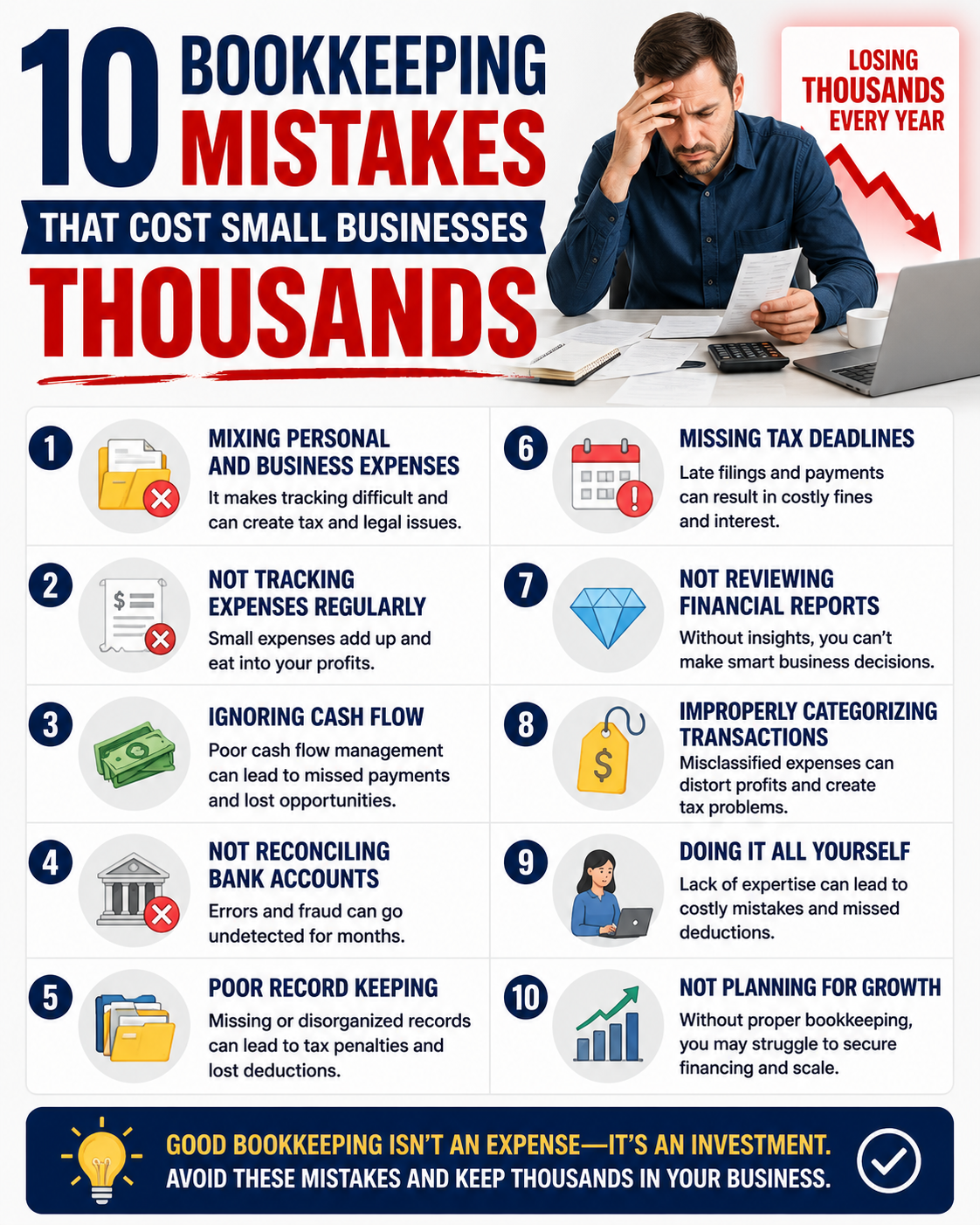
QuickBooks needs to be configured correctly for your specific business — your Chart of Accounts, your sales tax settings, your payroll setup, your inventory tracking. Most business owners set it up by guessing or clicking through the defaults. The result is a foundation that produces inaccurate reports from day one.
And the thing about a bad foundation is that every transaction you enter after that is built on top of it. Fixing a Chart of Accounts that’s been wrong for two years is a significant project.
Transactions Get Miscategorized
QuickBooks makes suggestions, but it doesn’t always get it right — especially for less common transactions or for expenses that could legitimately fall into more than one category. When transactions are miscategorized, your reports are wrong. Your profit looks different than it actually is. Your tax deductions are understated or overstated. And if those errors compound over months or years, untangling them is time-consuming and expensive.
Reconciliation Gets Skipped
Bank reconciliation — the process of matching your QuickBooks records to your actual bank statements — is one of the most important steps in bookkeeping. It’s also the step most DIY bookkeepers skip because it feels tedious and they’re not quite sure how to do it.
Without regular reconciliation, errors and duplicate transactions can go undetected for months. You might think your books are clean when they’re actually full of discrepancies that will cause problems at tax time.
It Takes More Time Than Expected
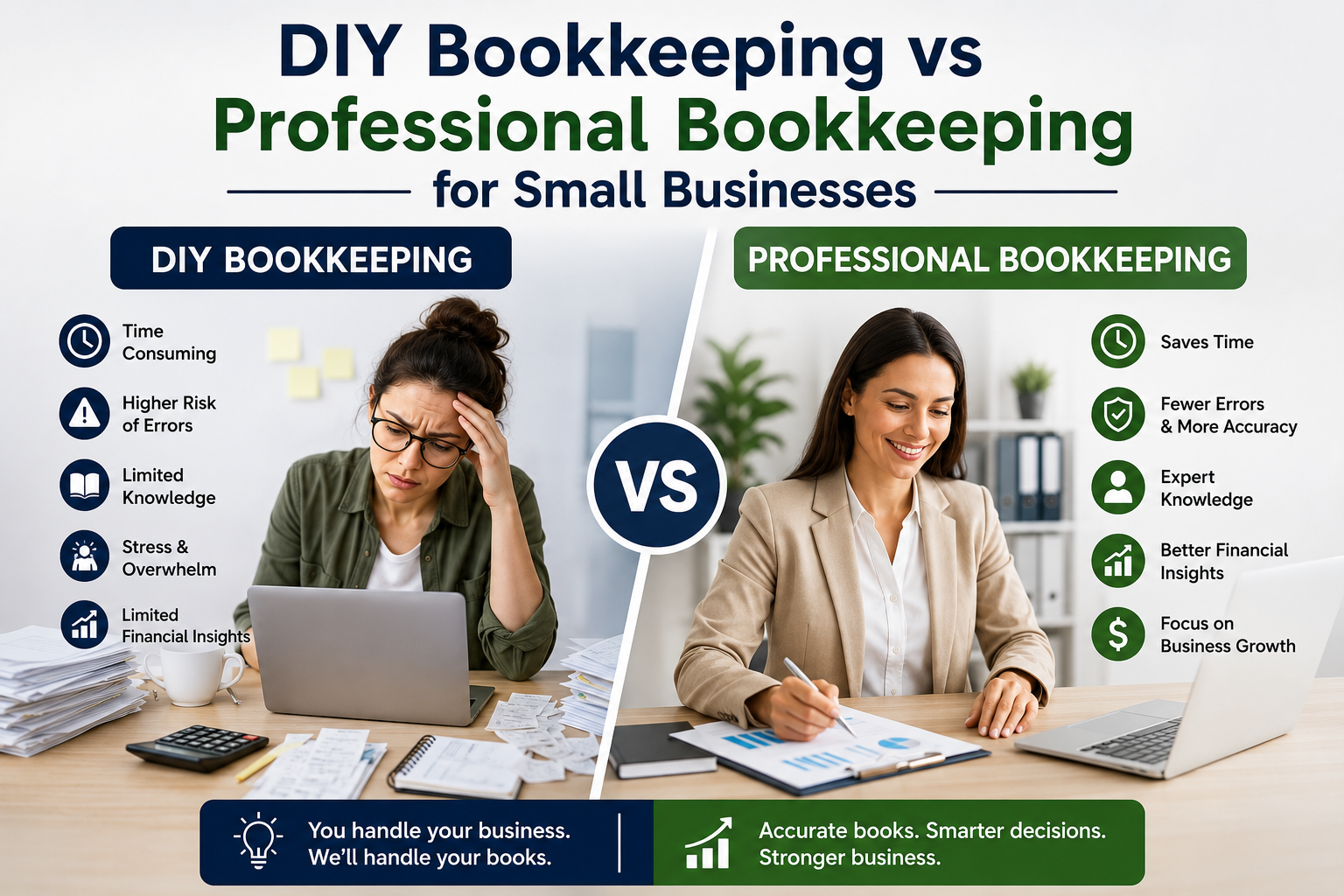
QuickBooks is supposed to save you time. And it does — when used correctly. But for business owners who are learning as they go, what should take a few hours a month can turn into a full weekend of frustration. Time you spend wrestling with your books is time you’re not spending on the work that actually grows your business.
You Don’t Know What You Don’t Know
This is the biggest hidden cost of DIY bookkeeping. QuickBooks will produce reports based on whatever data you’ve entered. It won’t tell you that you’re missing a major tax deduction. It won’t flag that your cash flow pattern suggests you’re heading toward a shortfall in 60 days. It won’t notice that you’ve been recording owner’s draws as expenses and artificially inflating your costs.
A professional bookkeeper notices all of those things. QuickBooks doesn’t.
What a Professional Bookkeeper Brings That QuickBooks Can’t
A bookkeeper isn’t just someone who enters data into QuickBooks. A good bookkeeper is a financial partner who keeps your books accurate, flags problems before they become crises, and gives you the information you need to make smart business decisions.
Here’s what you get with a professional bookkeeper that software alone can’t provide:
Accurate Setup and Configuration
A bookkeeper sets up QuickBooks correctly for your specific business from day one — the right Chart of Accounts for your industry, proper sales tax settings, correct payroll configuration, and the right reporting structure so the reports you generate actually mean something.
Consistent, Accurate Monthly Bookkeeping
Every month, your bookkeeper reconciles your accounts, categorizes your transactions correctly, reviews for errors or anomalies, and closes your books. You get accurate financial reports every single month — not just at tax time when it’s too late to do anything about problems.
Proactive Financial Insight
A good bookkeeper doesn’t just tell you what happened last month — they help you understand what it means and what’s coming. They’ll flag when your accounts receivable is getting too high, when your expenses are creeping up in a particular category, or when your cash position is trending in a direction that needs attention.
Tax Readiness Year-Round
With a bookkeeper keeping your records clean and organized all year, tax season stops being a scramble. Your accountant gets clean, organized books. Your deductions are properly documented. You’re not paying your CPA to sort through a mess — you’re paying them to do the strategic work they’re actually trained for.
Time Back in Your Day
For most business owners, the hours spent on bookkeeping each month are among the most stressful and least productive hours of their week. Handing that off to a professional gives you that time back — to focus on serving clients, growing your business, or simply not working on a Saturday.
Peace of Mind
There’s a real psychological cost to knowing your books are a mess or that you’re not sure if your numbers are right. When a professional is handling your bookkeeping, you know your records are accurate. That confidence has a value that’s hard to put a dollar figure on.
So Which Is Right for You?
Here’s a practical framework for thinking through the decision based on where your business is right now.
QuickBooks on Its Own Makes Sense If…
- You’re in the very early stages of your business with minimal transactions
- You have a background in accounting or finance and genuinely understand bookkeeping
- Your business structure is simple (sole proprietor, one bank account, no employees, no inventory)
- You have the time and discipline to stay on top of it consistently every month
- Your revenue is low enough that the cost of errors is manageable
Even in this case, having a bookkeeper review your setup and check your books once or twice a year is worth considering.
Hiring a Bookkeeper Makes Sense If…
- Your business is growing and transactions are increasing in volume and complexity
- You have employees or contractors and need to run payroll
- You carry inventory
- You’re spending more than a few hours a month on bookkeeping — or you’ve been avoiding it
- You’ve had tax surprises in the past that caught you off guard
- You want accurate monthly financials you can actually rely on to make decisions
- You’re planning to apply for a loan or line of credit
- You’re not confident your books are accurate and you’re not sure what’s wrong
The Best Combination: QuickBooks + a Bookkeeper
For most growing small businesses, the ideal setup is QuickBooks as the platform and a professional bookkeeper managing it for you. You get the power and accessibility of QuickBooks — you can log in anytime and see your reports — combined with the accuracy and expertise of someone who knows what they’re doing.
This is exactly how Thank Heavens Bookkeeping works with our clients. We manage your books in QuickBooks, keep everything organized and accurate, and give you clean financial reports every month. You always have access to your own data. You’re never locked out or dependent on us for basic information. But you don’t have to spend your weekends figuring out why your bank balance doesn’t match your QuickBooks balance.
What Does It Cost?
This is usually the first question — and it’s the right question to ask.
QuickBooks Simple Start begins at around $30 per month. QuickBooks Online Plus, which is what most small businesses need, runs around $90 per month. QuickBooks with Payroll adds to that.
Professional bookkeeping costs vary based on your transaction volume, complexity, and what services are included. For most small businesses, monthly bookkeeping support is more affordable than people expect — and when you factor in the time saved, the tax deductions you stop missing, and the accounting fees you save by handing your CPA clean books, it often more than pays for itself.
The real question isn’t “can I afford a bookkeeper?” It’s “what is doing my own bookkeeping actually costing me?” — in time, in errors, in missed deductions, and in the mental load of knowing your finances aren’t quite right.
Ready to Find Out What’s Right for Your Business?
At Thank Heavens Bookkeeping, we work with small business owners across Hanover, PA and the United States to set up QuickBooks correctly, keep books clean and accurate every month, and give business owners the financial clarity they need to grow with confidence.
Whether you’re starting from scratch, cleaning up years of DIY bookkeeping, or just looking for a better system, we’d love to talk.
Call us at (717) 965-0680 or visit thankheavensbookkeeping.com/contact to schedule your free consultation.
Because the right financial system — built for your business — changes everything.
Thank Heavens Bookkeeping provides bookkeeping, payroll, accounts receivable, accounts payable, and cleanup services for small businesses in Hanover, PA, York, PA, Lancaster, PA, Harrisburg, PA, and remotely across the United States