
Key Takeaways
- Understand why Business Cash Flow is all about timing and how to track the money moving in and out of your bank account.
- Learn why a profitable business can still run out of cash and how to measure the real-time availability of your funds.
- Identify common habits, like slow invoicing or mixing personal expenses, that are quietly draining your bank balance.
- Discover how weekly reconciliations and simple reports in QuickBooks Online can give you total clarity and peace of mind.
- See how partnering with a professional bookkeeper can move you from financial chaos to a place of confidence and growth.
What Is Business Cash Flow? (More Than Just Money in the Bank)
Think of your business as a living, breathing entity. It needs more than just a high sales goal to survive; it needs constant movement. Many owners I talk to in Hanover and York feel a sense of dread when they look at their bank balance, even after a busy week of service. This happens because they’re looking at a static number rather than the movement of their money. Business cash flow is simply the timing of when money enters and leaves your business. It isn’t just about the total amount you earned this year. It’s about whether that money is actually in your hand when the landlord or your employees need to be paid.
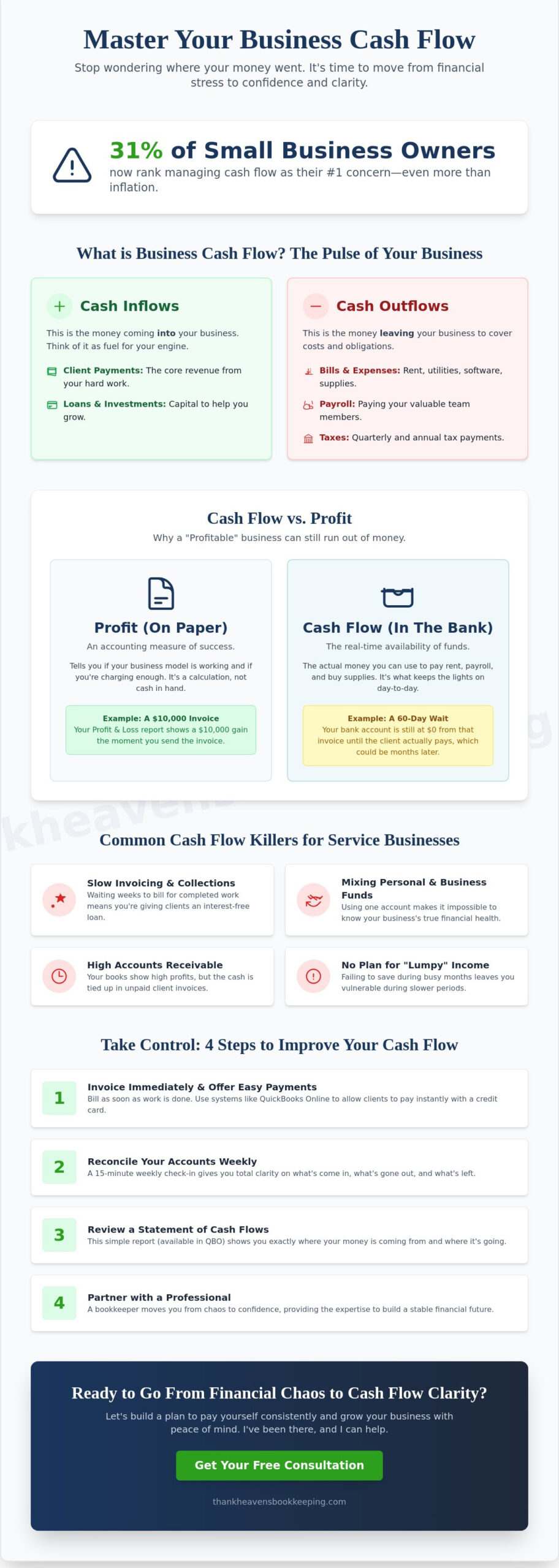
To understand the pulse of your business, you have to look at the two sides of the coin: inflows and outflows. Cash inflow is the money coming toward you. This primarily includes collected payments from your clients, but it can also come from business loans or interest earned. Cash outflow is everything moving away from you. This covers your monthly bills, payroll, equipment costs, and tax payments. While your profit tells you if your business model is working, your cash flow tells you if you can keep the lights on tomorrow morning.
Business cash flow is the essential lifeblood that keeps your doors open and your operations running regardless of your total sales volume.
Positive vs. Negative Cash Flow: What They Really Mean
Positive cash flow is that wonderful feeling of relief when you have more money landing in your account than you have scheduled to leave it. It means you have the flexibility to grow or handle a surprise repair. Negative cash flow, on the other hand, means you’re spending more than you’re bringing in during a specific window of time. This happens often in the service industry, especially if you have “lumpy” income or clients who are slow to pay. You can identify your state today by looking at your bank reconciliations; if your balance is trending down despite high sales, you likely have a timing issue that needs a gentle, expert hand to fix.
The Three Types of Cash Flow Every Owner Should Know
Understanding where your money goes helps clear the mental fog of business ownership. There are three main categories you should track:
- Operating Cash Flow: This is the most important one. It’s the money generated by your core services, like plumbing, consulting, or landscaping.
- Investing Cash Flow: This tracks money spent on long-term assets. If you bought a new service van or upgraded your office computers, that’s an investment in your future.
- Financing Cash Flow: This involves the “big” money movements, such as taking out a business loan or when you pay yourself an owner’s draw to cover your own family’s expenses.
Cash Flow vs. Profit: Why You Can Be Profitable and Still Broke
It’s a story I hear often from business owners in Hanover and York. You look at your reports at the end of the month and see a healthy profit. You should be celebrating. Instead, you’re staring at your bank balance wondering how you’re going to cover next week’s payroll. This is the confusing gap between profit and Business Cash Flow. Profit is a “paper” measurement of your success over a period of time. It tells you that your business model is working. But cash flow is the real-time availability of funds. It’s the actual money sitting in your account right now that you can use to pay bills.
The danger of “paper profits” is that they can’t buy supplies or pay your team. Imagine you just finished a $10,000 project for a client in Gettysburg. You’ve done the work, paid for the materials, and sent the invoice. On paper, you just earned $10,000. However, if that client takes 60 days to send the check, you are effectively “broke” for those two months. You have the profit, but you don’t have the cash. This gap is where most small business owners feel the most stress.
The “Profitable but Broke” Trap
High accounts receivable, which is just a fancy way of saying money people owe you, often masks deep cash problems. Your books might show you’re doing great, but those figures are just promises until the money hits your bank. Timing is the real culprit here. Your expenses, like your rent or software subscriptions, hit your account on a strict schedule. If your revenue arrives on a “whenever” schedule, you’re trapped. Your Profit and Loss statement is a vital tool, but it doesn’t show you these dangerous gaps in your timing.
Key Differences at a Glance
Profit focuses on earnings, while Business Cash Flow focuses on timing. To make smarter decisions, you need to look at both metrics together. Profit tells you if you’re charging enough for your services. Cash flow tells you if you can afford to hire that next employee or buy new equipment today. Profit is a goal, but cash is the requirement to reach it.
If you’re feeling the weight of these financial riddles, we can help you find the clarity you deserve so you can stop guessing and start growing with peace of mind.
Common Cash Flow Killers for Service-Based Businesses
Even if you understand the difference between profit and bank balances, certain habits can quietly drain your accounts. These “killers” are often invisible until you’re staring at a bill you can’t quite cover. In my years helping service providers in Hanover and Gettysburg, I’ve seen that the biggest threats to Business Cash Flow aren’t usually a lack of sales. Instead, they are small, daily choices that create a massive backlog over time. One of the most common culprits is the “I’ll bill them later” mentality. When you’re busy serving clients, invoicing feels like a chore you can push to the weekend. But every day you wait to send that invoice is another day your cash is sitting in someone else’s pocket instead of yours.
Another silent drain is the tendency to over-invest in tools or software before your revenue truly supports them. It’s tempting to buy the latest high-end equipment or a premium subscription because it promises to make life easier. However, if those monthly outflows hit before your client payments arrive, you’re putting unnecessary pressure on your Business Cash Flow. Additionally, failing to set aside money for taxes or 1099 contractors can lead to a heart-stopping realization during tax season. Without a plan, those large, predictable expenses feel like sudden emergencies that wipe out your working capital.
The High Cost of Messy Books
Mixing your personal and business expenses is a recipe for what I call “financial fog.” When you use your business card for a quick grocery run or gas for the family car, you’re making it nearly impossible to see your true financial health. These unorganized records lead to missed tax deductions and slow leaks where money just seems to vanish. If you feel like you’ve lost the trail of your finances, our clean-up services can help you hit the reset button. Clearing that fog is the first step toward feeling like the confident leader your business needs.
Accounts Receivable: Your Biggest Asset or Your Biggest Headache?
Your cash cycle depends entirely on how quickly you move money from an “invoice sent” to “payment received.” Many owners default to “Net 30” terms because it sounds professional, but for a small service business, “Net 15” or even payment upon receipt might be more appropriate. Proactively managing your accounts receivables ensures that your hard work translates into actual liquidity. A simple but effective tip is to automate your reminders. Most software allows you to send a gentle nudge three days before a bill is due and again the day after, taking the awkwardness out of the conversation and keeping your bank account full.
How to Manage and Improve Your Business Cash Flow
Taking control of your finances doesn’t have to feel like a second full-time job. When you move from reactive guessing to proactive management, that heavy weight on your shoulders finally starts to lift. Improving your Business Cash Flow is about creating a system that works for you, rather than you working for your bank account. I’ve found that for my neighbors in Hanover and York, the most effective way to gain this control is through small, consistent steps that build a clear picture of your financial health.
- Reconcile your accounts weekly: Waiting until the end of the year, or even the end of the month, leaves you flying blind. Spending fifteen minutes a week ensures your books match reality.
- Run a Statement of Cash Flows: Within QuickBooks Online, this specific report shows you exactly where your money originated and where it went, providing a deeper look than a standard profit report.
- Forecast the next 30 days: Look at your calendar. List every known bill and every expected payment. This simple habit eliminates the “surprise” factor of upcoming expenses.
- Shorten your billing cycle: If you currently give clients 30 days to pay, try moving to 14 days or requiring payment upon completion. This keeps your cash cycle moving faster.
- Review your monthly financial reporting: Regularly looking at professional financial reports helps you spot trends before they become problems.
Using QuickBooks Online for Cash Flow Clarity
QuickBooks Online is a powerful tool when it’s set up correctly. The “Cash Flow Center” in your dashboard is a great place to start, as it provides a visual representation of your money’s movement. However, the data is only as good as the categorization behind it. If your transactions are a mess, your dashboard will be too. Many owners find that a bit of QuickBooks training provides the relief they need to use the software with confidence rather than confusion.
Actionable Tips to Boost Your Bank Balance Today
Beyond the software, there are practical shifts you can make right now. Try negotiating better terms with your own vendors; sometimes simply asking for an extra ten days to pay a bill can provide the breathing room you need. For large projects in the service industry, implement a “deposit-first” policy to cover your initial costs. Finally, take a hard look at your bank statement for “zombie” subscriptions. Those small, forgotten monthly charges for tools you no longer use can add up to hundreds of dollars in lost cash over a year.
If you are ready to trade financial chaos for a predictable bank balance, reach out to us today to see how we can help you master your numbers.
Moving from Financial Chaos to Cash Flow Clarity
The constant noise of unfinished administrative tasks is exhausting. When you spend your Sunday nights trying to figure out why your bank account doesn’t match your sales, you’re losing more than just time; you’re losing your peace of mind. I’ve been in that seat, and I know that the mental weight of “not knowing” is often heavier than the work itself. Moving from financial chaos to clarity isn’t just about cleaning up a spreadsheet. It’s about how you feel when you wake up on Monday morning, ready to face the week with a sense of calm and control.
Mastering your Business Cash Flow is a transformative moment for any service provider in Hanover or York. You started your business because you have a passion for serving your clients, not because you wanted to become a full-time accountant. When you have a partner who finds joy in the details that you find daunting, that weight finally lifts. “Thanking heavens” for organized finances isn’t just a catchy phrase. It’s a strategic move that allows you to stop playing defense and start playing offense with your growth goals.
Why Professional Bookkeeping Is Your Secret Weapon
Outsourcing your books is the fastest way to get hours of your life back every single week. Instead of wrestling with transaction categories, you can spend that time on high-value projects or finally being present with your family. There is a profound sense of relief that comes with knowing your tax-ready paperwork is being handled meticulously by an expert. You move away from making “gut-feeling” guesses about what you can afford and start making data-driven decisions that actually move the needle for your profit margins.
Your Sanctuary for Financial Management
At Thank Heavens Bookkeeping, we aim to be more than just a service provider. We want to be your sanctuary in the midst of entrepreneurial stress. Heaven and our dedicated team are deeply invested in your success, acting as a reliable advocate for your business’s financial health. We take pride in the orderly nature of our work so you can find lightness in yours. You can learn more about our ProAdvisor expertise and our heart for small businesses to see why so many of your neighbors trust us with their numbers.
You’ve worked too hard to let messy books hold you back from the success you deserve. Ready for clarity? Schedule a consultation today.
Take the Lead on Your Financial Future
You now have the tools to move from financial fog to total clarity. Mastering your Business Cash Flow is about more than just numbers; it’s about reclaiming your time and your peace of mind. By tracking the timing of your money and keeping your personal expenses separate, you’ve already taken the first step toward a more predictable bank balance. You don’t have to carry the weight of your books alone anymore.
As a Certified QuickBooks Online ProAdvisor specializing in service-based businesses, I’m here to provide the empathetic, non-judgmental support you need to thrive. We find joy in the details that others find daunting, and we’d love to help you find that same lightness in your own work. Let us handle the numbers so you can focus on your passion; Contact Thank Heavens Bookkeeping today.
You started your business to serve your community and build something meaningful. You deserve to grow with confidence and sleep soundly knowing your finances are in expert hands.
Frequently Asked Questions
What is the simplest way to calculate my business cash flow?
The simplest way to calculate your cash flow is to subtract your total cash outflows from your total cash inflows over a specific period, such as a month. This gives you your net cash flow. Unlike profit, this calculation only looks at the actual money that cleared your bank account, giving you a real-time view of your current spending power and financial health.
Is cash flow more important than profit for a new business?
Cash flow is generally more important than profit for a new business because it determines your daily survival. You can have a profitable business model on paper, but if you don’t have liquid cash to pay your rent or local vendors in York, you won’t stay in business long enough to see those profits. Liquid cash is what keeps your doors open while you grow.
How often should I review my cash flow statement?
You should review your cash flow statement at least once a month during your regular financial check-in. If your business is growing quickly or you’re navigating a tight season, checking it weekly provides a much-needed sense of relief. Frequent reviews help you spot timing issues before they turn into bank account emergencies, keeping your stress levels low and your plans on track.
Can QuickBooks Online help me predict my future cash flow?
QuickBooks Online can definitely help you predict your future Business Cash Flow through its built-in planner tool. By looking at your historical data and upcoming scheduled transactions, the software creates a forecast of your bank balance. It’s a great way to see if you’ll have enough to cover that big equipment purchase or a 1099 contractor payment next month without the guesswork.
Why is my bank balance lower than the profit on my P&L?
Your bank balance is often lower than your profit because profit includes money you’ve earned but haven’t actually received yet. If you have outstanding invoices, that counts as profit but isn’t in your bank account yet. Additionally, things like loan principal payments or owner’s draws don’t show up as expenses on your P&L, but they certainly reduce your actual cash on hand.
What are the quickest ways to improve my cash flow this month?
The quickest way to improve your cash flow this month is to follow up on every single overdue invoice immediately. You can also start requiring a deposit for new service projects in Gettysburg or Hanover to bring cash in the door sooner. Finally, look for any non-essential expenses or subscriptions you can cancel today to keep more money in your account where it belongs.
Do I need a separate bank account for business taxes?
Yes, opening a separate savings account specifically for your business taxes is one of the best things you can do for your peace of mind. Setting aside a percentage of every payment you receive ensures the money is there when the IRS or state comes calling. This simple habit prevents you from accidentally spending your tax money on operating costs, which is a major source of anxiety.
When should I hire a professional bookkeeper to manage my cash flow?
You should hire a professional bookkeeper when managing your Business Cash Flow starts to feel like a burden that takes you away from your craft. If you’re consistently stressed about tax deadlines or feel a sense of dread when opening your bank app, it’s time for an expert hand. A reliable partner can provide the clarity and organization you need to grow your business with confidence.

Article by
Joshua Parsley
Joshua Parsley is the founder of Thank Heavens Bookkeeping, where he helps small business owners organize their finances, understand their numbers, and gain more time back to focus on growing their business.
Specializing in bookkeeping support for service-based businesses, Joshua works with business owners who feel overwhelmed by messy books, cash flow confusion, and falling behind on financial organization. His approach focuses on simplifying bookkeeping, improving financial clarity, and helping owners make smarter business decisions with confidence.
Drawing from both personal experience and hands-on work with small businesses, Joshua creates practical educational content around bookkeeping, QuickBooks Online, profit improvement, and financial organization for entrepreneurs.
Through Thank Heavens Bookkeeping, his mission is to help hardworking business owners reduce stress, stay organized, and build stronger businesses through reliable bookkeeping support.